W.B. Yeats (1865-1939) :

W.B. Yeats was an Irish poet, playwright, and senator who was a central figure in the Celtic Twilight movement and one of the leading voices of 20th-century English-language poetry. Yeats is considered one of the greatest poets of the 20th century and his works often explore themes of love, death, and the occult. Some of his most famous works include "The Lake Isle of Innisfree," "When You Are Old," "The Second Coming," and "Sailing to Byzantium."
W.B. Yeats was born on June 13, 1865, in Dublin, Ireland.
He died on January 28, 1939, in Roque rune - Cap-Martin, France at the age of 73.
W.B. Yeats was awarded the Nobel Prize in Literature in 1923 "for his always inspired poetry, which in a highly artistic form gives expression to the spirit of a whole nation." The Nobel Prize in Literature is awarded annually to an author from any country who has produced in the field of literature "the most outstanding work in an ideal direction." Yeats' works are known for their themes of love, death, and the occult, as well as their powerful imagery and musicality. His contributions to modernist literature and his ability to give voice to the Irish cultural and national identity were also factors in his winning the Nobel Prize.
Poems :
"The Second Coming"
Turning and turning in the widening gyre
The falcon cannot hear the falconer;
Things fall apart; the centre cannot hold;
Mere anarchy is loosed upon the world,
The blood-dimmed tide is loosed, and everywhere
The ceremony of innocence is drowned;
The best lack all conviction, while the worst
Are full of passionate intensity.
Surely some revelation is at hand ;
Surely the Second Coming is at hand.
The Second Coming! Hardly are those words out
When a vast image out of Spiritus Mundi
Troubles my sight: somewhere in sands of the desert
A shape with lion body and the head of a man,
A gaze blank and pitiless as the sun,
Is moving its slow thighs, while all about it
Reel shadows of the indignant desert birds.
The darkness drops again; but now I know
That twenty centuries of stony sleep
Were vexed to nightmare by a rocking cradle,
And what rough beast, its hour come round at last,
Slouches towards Bethlehem to be born?
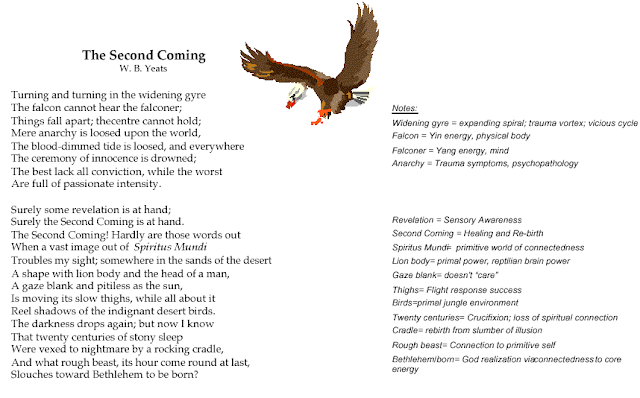
Outka makes it clear that the pandemic wasn’t “forgotten”—it just went underground. Reading as a pandemic poem.
"The Second Coming" is a poem written by W.B. Yeats, first published in 1919 in his collection "Michael Robartes and the Dancer". It's a canonical poem. The poem is widely regarded as one of Yeats' masterpieces and a cornerstone of Modernist poetry.
The poem explores themes of disillusionment, societal change, and spiritual turmoil, and is often interpreted as a meditation on the aftermath of World War I and the decline of Western civilization.
The famous line "The center cannot hold" reflects Yeats' concern about the loss of tradition and the chaos that was emerging in the world around him.
The line "The center cannot hold" from W.B. Yeats's poem "The Second Coming" refers to the idea of societal and cultural decay and the loss of stability in the world. It suggests that the central values, beliefs, and norms that previously held society together are no longer able to maintain their influence and control, leading to a breakdown of order and the rise of chaos. The line is often interpreted as a commentary on the sense of uncertainty and upheaval in the aftermath of World War I and the decline of Western civilization. He indicates that the digression of social values is very harmful.

The lines suggest that the loss of stability and moral authority has led to a sense of moral decay and a rise of evil. The lines are often interpreted as a commentary on the aftermath of World War I and the decline of Western civilization, reflecting a sense of disillusionment.
They describe a society in which traditional values and norms have broken down and the once virtuous and moral individuals have lost their sense of purpose and conviction, while those who are considered evil or wicked are full of conviction and drive.
That means good people lose their faith and evil is motivated to do bad things.

The poem describes a world that is falling apart, and Yeats uses vivid imagery to evoke a sense of chaos and uncertainty. The "vast image out of Spiritus Mundi" refers to a vision of the future that Yeats sees, and the "shape with lion body and the head of a man" represents a monstrous creature that is coming into being.
The creature's "gaze blank and pitiless as the sun" suggests that it is indifferent to human suffering, and the "shadows of the indignant desert birds" suggest that it is causing widespread destruction.
The final lines of the poem are particularly haunting, as Yeats suggests that the creature's arrival has been foretold by the "twenty centuries of stony sleep" - a reference to the two thousand years that have passed since the birth of Christ. The "rough beast" that is slouching towards Bethlehem is a symbol of chaos and destruction, and the poem ends on a note of uncertainty and dread, as Yeats wonders what kind of world this creature will bring forth when it is born.
- Bethlehem- Where Jesus Christ first born.
"On Being Asked for a War Poem"
I think it better that in times like these
A poet's mouth be silent, for in truth
We have no gift to set a statesman right;
He has had enough of meddling who can please
A young girl in the indolence of her youth,
Or an old man upon a winter’s night.

A rhyme scheme ABC, ABC and written in Iambic Pentameter. The first three lines refer to the poet’s attitude to writing about war; the next three lines write on the self-imposed limits of the poet’s interventions in the world. (Analysis)
His (W.B.Yeats) line ‘We have no gift to set a statesman right’ is a forerunner to Auden’s famous line that ‘poetry makes nothing happen’, and the similarity is no coincidence: Auden makes that well-known statement in his elegy for W. B. Yeats, written in 1939.
"On Being Asked for a War Poem" was written in 1915, during the early years of World War I. The poem explores Yeats' struggle with the expectations placed upon him as a poet to write about the war.
In the poem, Yeats begins by acknowledging the request for a war poem, but quickly expresses his hesitation to write one. He suggests that war poems are not as simple as they may seem, and that the subject matter is difficult for a poet to approach. He also suggests that war is not a suitable subject for poetry, as it is an ugly and violent experience.
Yeats then goes on to describe the complexity of war, stating that it is not simply a matter of good versus evil. He suggests that war is a struggle between two opposing forces, both of which may believe they are fighting for what is right. He describes the horror and tragedy of war, and suggests that it is not something that can be easily captured in a poem.
The final stanza of the poem contains a powerful image of a soldier who has died in battle, and the futility of the conflict in which he fought. Yeats suggests that there is no glory in war, and that the true tragedy lies in the loss of life that it causes.
Why he wrote this poem?
He wrote the poem "On Being Asked for a War Poem" in response to a request for him to write a poem about the ongoing World War I. At the time, Yeats was living in Ireland, which was not directly involved in the war, and he had mixed feelings about it.
Yeats was deeply affected by the war and the senseless loss of life it caused. He was also struggling with his own role as a poet in the midst of such a devastating event. In the poem, Yeats expresses his hesitation to write a war poem, as he believes that war is not a suitable subject for poetry.
Yeats was a complex and politically engaged poet, who used his work to explore his thoughts on Irish nationalism and other political issues. In the context of his wider body of work, "On Being Asked for a War Poem" can be seen as part of his larger commentary on the devastating effects of war and the human condition in general.
Yeats wrote this poem to express his own personal feelings about war and the difficulties he faced as a poet in addressing such a challenging subject. The poem also reflects Yeats' larger political and philosophical concerns, which were a central focus of his work.
(Words 1493, Photos 05, Videos 04)


